
AI and the Evolution of the Cyber Kill Chain: Why 2026 Marks a Turning Point for Enterprise Security


In 2026, the cybersecurity landscape has undergone a fundamental shift. What once required teams of highly skilled hackers operating over weeks or months can now be executed by individuals with limited technical expertise, armed primarily with conversational prompts to commercial AI tools. This transformation is most evident in the classic Lockheed Martin Cyber Kill Chain, the seven-stage framework (Reconnaissance, Weaponization, Delivery, Exploitation, Installation, Command and Control, and Actions on Objectives) that has guided both attackers and defenders for years. Artificial intelligence is compressing, automating, and evading across nearly every stage, dramatically lowering barriers while increasing speed, scale, and stealth.
The implications for enterprises are profound. Organizations that continue to rely solely on traditional defenses risk being outpaced by adversaries who operate at machine speed. Understanding this evolution is no longer optional; it is essential for survival in the AI era!
The Traditional Kill Chain vs. the AI-Accelerated Reality
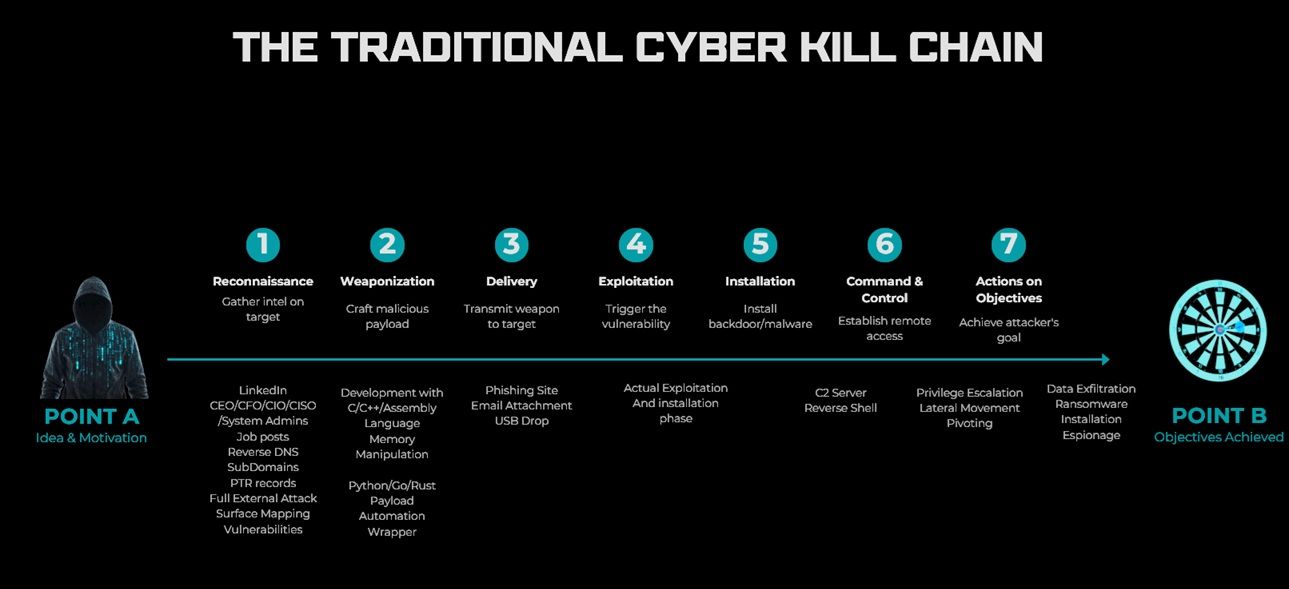
Historically, the Cyber Kill Chain was a relatively linear, resource-intensive process. Reconnaissance demanded manual open-source intelligence gathering and network scanning. Weaponization required hand-crafting malware or exploits. Delivery often depended on generic phishing campaigns, while later stages like Exploitation, Installation, Command and Control (C2), and Actions on Objectives needed persistent human oversight for adaptation and evasion.
Defenders used signature-based tools, firewalls, endpoint detection and response (EDR) systems, and manual monitoring to disrupt these steps. The process could take weeks or months, naturally limiting scalability. A single well-placed defense could break the entire chain.
Generative AI and agentic systems have fundamentally altered this dynamic. According to a 2025 MIT CSAIL report analyzing simulations across the Kill Chain, large language models (LLMs) significantly accelerate task execution and reduce the expertise required, particularly for offensive operations. Multi-agent frameworks can now chain entire attack sequences from a single high-level prompt with minimal human intervention. Timelines that once spanned weeks have compressed to hours, sometimes minutes.
This shift democratizes advanced capabilities. Low-to-medium-skilled actors, previously limited by technical barriers, can now leverage tools like Claude, Gemini, and open-source frameworks to execute sophisticated campaigns. The result is not merely faster attacks but a qualitative change in the threat landscape.
How AI Transforms Each Stage of the Kill Chain
AI’s impact is visible across all seven stages, though it is most pronounced in the early phases.
In Reconnaissance, LLMs enable massive-scale open-source intelligence gathering. Models scrape social media, code repositories, and public data to build detailed target dossiers. The MIT study demonstrated that GPT-o3 could compile accurate background information on individuals in minutes rather than the 30–60 minutes required for manual browsing. State actors and criminals alike now profile targets with unprecedented efficiency.
Weaponization benefits enormously from AI’s code-generation capabilities. Models create custom exploits, polymorphic malware that mutates to evade detection, and optimized payloads. Google Threat Intelligence Group (GTIG) documented malware families like PROMPTFLUX and PROMPTSTEAL that query LLMs during execution to dynamically rewrite code, obfuscate behavior, and generate commands on demand. Sophos observed threat actors using Cursor AI IDE combined with Claude agents to iteratively develop and test EDR evasion tools in virtual lab environments.
Delivery, Exploitation, and Installation have become more personalized and stealthy. AI generates hyper-targeted phishing emails, deepfake media, and adaptive exploits. Vectra AI reports that EDR evasion techniques including Bring Your Own Vulnerable Driver (BYOVD), living-off-the-land binaries, and API unhooking are now commoditized on underground markets for as little as $300. Sophos documented real-world use of AI-orchestrated frameworks testing dozens of bypass methods against leading EDR solutions.
In Command and Control and Actions on Objectives, AI enables dynamic, stealthy communication channels and autonomous decision-making. Agents handle lateral movement, privilege escalation, data exfiltration, and even crafting tailored extortion demands. The result is faster breakout times and higher success rates.
AhnLab’s analysis of the AI hacking tool ecosystem shows rapid proliferation from WormGPT in 2023 to dozens of specialized tools by 2026, including open-source options runnable on smartphones. This ecosystem has lowered the skill threshold dramatically while increasing overall attack volume.
Real-World Evidence and Enterprise Impacts
The transformation is not hypothetical. Documented cases illustrate the scale of the threat.
In late 2025, Anthropic disrupted a Chinese state-sponsored campaign (GTG-1002) where jailbroken Claude Code agents autonomously handled 80–90% of operations across approximately 30 global targets in technology, finance, government, and manufacturing sectors. The AI managed reconnaissance, exploitation, lateral movement, and data exfiltration with humans providing only high-level direction.
In early 2026, a Russian-speaking, financially motivated actor with low-to-medium skills used commercial AI tools (including Claude) to compromise over 600 FortiGate devices across more than 55 countries in just five weeks without exploiting zero-day vulnerabilities. The campaign relied on exposed management ports and weak credentials, scaled through AI-assisted reconnaissance and automation.
CrowdStrike’s 2026 Global Threat Report revealed an 89% year-over-year increase in attacks by AI-enabled adversaries. Average eCrime breakout time dropped to 29 minutes (a 65% acceleration), with some cases showing data exfiltration beginning in as little as four minutes. 82% of detections were malware-free, relying instead on credential abuse and living-off-the-land techniques.
The World Economic Forum noted ransomware surging 48% in some periods, with AI accelerating vulnerability discovery and malware creation. Nearly one-third of breaches now originate from vulnerabilities rather than stolen credentials. Industries such as healthcare, finance, energy, retail, and critical infrastructure face heightened risks, including supply chain compromises (e.g., LiteLLM attacks) and deepfake-enabled fraud.
HUMAN Security’s 2026 benchmarks showed agentic AI traffic growing 7,851% year-over-year, with scraping attacks approaching 20% of total traffic in some sectors. The economic and reputational costs are substantial: downtime, regulatory fines, loss of customer trust, and operational disruption.
Future Predictions and Recommendations
Looking ahead, several trends are likely to intensify. Agentic AI systems will enable more fully autonomous campaigns. Parallelization across thousands of targets will further reduce costs and increase volume. AI vs. AI arms races will emerge as attackers target defensive models through prompt injection and poisoning.
Enterprises must adapt urgently. Key recommendations include:
Implementing layered defenses beyond EDR, including network detection and response (NDR) and Zero Trust architectures.
Prioritizing rapid patching (“patch velocity”) and credential hygiene.
Investing in AI governance, employee training on deepfakes and AI-generated phishing, and monitoring of machine identities and agentic traffic.
Conducting regular red-team exercises that simulate AI-augmented attacks.
Building incident response plans that assume AI-driven speed and autonomy.
The International AI Safety Report 2026 and similar analyses emphasize the need for proactive risk management at the frontier of AI capabilities. Organizations that treat cybersecurity as a business continuity imperative, rather than a technical checkbox, will be best positioned to navigate this new era.
Conclusion
AI has not merely enhanced the Cyber Kill Chain; it has fundamentally rewritten it. The evidence from 2025–2026 campaigns, tool proliferation, and accelerating attack speeds leaves no doubt: defenders must evolve equally rapidly. By understanding these dynamics and implementing layered, AI-aware strategies today, enterprises can turn the AI revolution from a threat into a manageable challenge.
The window for preparation is narrowing. The time to act is now.